
Categories
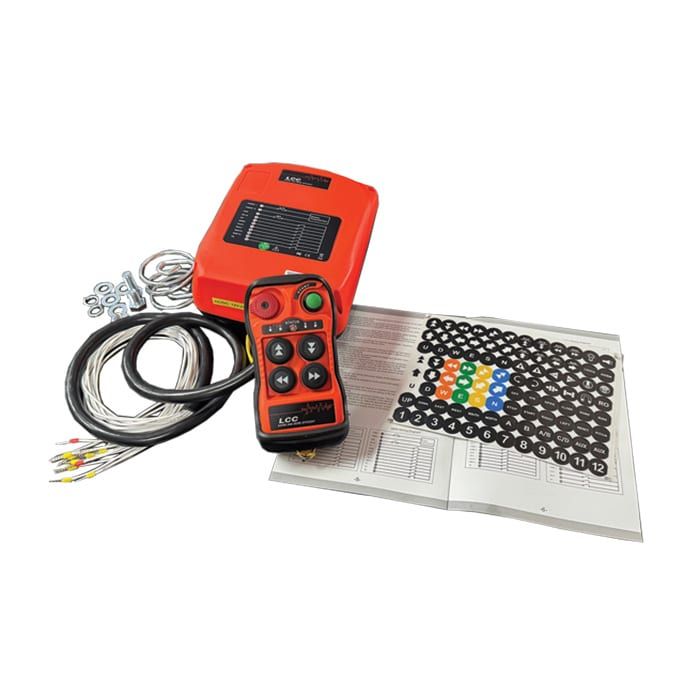
Q Series Wireless Remote Control Kits 4, 8 or 12 Functions, 433MHz IP65
SKU Q400
AU$623.52
On Sale
was AU$666.72 Save 6%
Number of Functions
Please choose
In stock
1
Save this product for later
Customer reviews
Reviews only from verified customers
No reviews yet. You can buy this product and be the first to leave a review.
Q Series Wireless Remote Control Kits 4, 8 or 12 Functions, 433MHz IP65
Product Details
Weight: 0.38 kg
Q Series Wireless Remote Control Kits – 4, 8 or 12 Functions, 433 MHz
A complete radio remote kit: handheld transmitter, receiver, function sticker sheet and user manual. Press a button on the handset, the matching relay closes at the receiver. Use it to run solenoid valves, contactors, winches, tippers, tail lifts or a power pack from up to 100 metres away, without running a control cable to the operator.
Both halves are IP65 in glass-filled nylon housings and run from −10°C to +75°C, so they are built for the outside of a truck rather than the inside of a switchboard.
Ways to buy:
- Off the shelf – pick 4, 8 or 12 functions below.
- Count your functions before you order: each direction is a function. A single double-acting ram is two.
- Not sure the receiver suits your supply? Call us with your voltage – it covers 24 – 48 V low voltage and 110 – 460 V AC or DC high voltage.
Pick your kit
| Kit | Transmitter functions | Handset size | Part number |
| 4 Functions | 4 single-speed functions | 14.5 x 7.5 x 3.8 cm | Q400 |
| 8 Functions | 8 single-speed functions | 19 x 7.2 x 3.9 cm | Q800 |
| 12 Functions | 12 single-speed functions | 23.9 x 7.2 x 3.9 cm | Q1200 |
What is in the box
- Handheld transmitter (batteries: 2 x AA, DC 3V)
- Receiver unit
- Function sticker sheet so the handset can be labelled for the machine
- User manual
Transmitter specifications
| Parameter | Value |
| Frequency | 433 MHz |
| RF power | Less than 10 mW |
| Remote control distance | 100 m |
| Power supply | 2 x LR6 (AA) 1.5 V, DC 3 V |
| Modulation | GFSK |
| Frequency control | PLL |
| Antenna impedance | 50 Ω |
| Command response time | Less than 100 ms |
| Stop command response time | Less than 100 ms |
| Average power consumption | 8 mA at DC 3 V |
| Working temperature | −10°C to +75°C |
| Net weight with battery | 380 g |
| Case material | PA6 with 30% glass fibre |
| Protection level | IP65 |
Receiver specifications
| Parameter | Value |
| Frequency | 433 MHz |
| Sensitivity | −112 dBm |
| Remote control distance | 100 m |
| Power supply, low voltage | 24 V to 48 V AC or DC |
| Power supply, high voltage | 110 V to 460 V AC or DC |
| Modulation | GFSK |
| Frequency control | PLL |
| Antenna impedance | 50 Ω |
| Reaction time | 50 to 100 ms |
| Contact rating | 5 A at 250 V |
| Average power consumption | 15 mA at AC 220 V |
| Operating temperature | −10°C to +75°C |
| Case material | PA6 with 30% glass fibre |
| Protection level | IP65 |
How to choose
- Count functions as movements, not circuits. Up and down is two functions. A tipper with a body raise, a body lower and a tailgate release is three.
- Buy one size up if there is any chance of adding a function later – retro-fitting a bigger handset means a new receiver as well.
- Check your supply against the receiver: 24 – 48 V for the low voltage input, 110 – 460 V for the high voltage input.
- Check the load. The receiver contacts are rated 5 A at 250 V – ample for a solenoid coil or a contactor coil, not for a motor.
Technicians Advice
Mount the receiver high and clear of steel. The quoted 100 metres is line of sight in open air; bolt the receiver low behind a chassis rail or inside a steel box and you will lose most of it, then blame the remote. Keep the antenna vertical, keep it away from the alternator, the inverter and any PWM valve driver, and never coil the surplus antenna lead around the loom.
Drive relays or solenoid coils with the receiver contacts and nothing heavier – 5 A at 250 V is a control rating, not a load rating, and a motor started directly through it will weld the contacts. Label the handset with the sticker sheet before it goes out, not after: an unlabelled 8-function remote on a tipper is a genuine safety problem, because the operator will eventually press the wrong one.
Test the stop command from the far end of the working area before the machine is signed off, and carry spare AA batteries – a handset going flat mid-lift is the failure everybody meets once. On any machine where an unintended movement could hurt somebody, the radio remote is a convenience layer: it does not replace an isolator the operator can reach.
Need help choosing? Call 1300 146 737 or email sales@mhfgc.com.au – real technicians, real answers.
Display prices in:AUD