
Categories
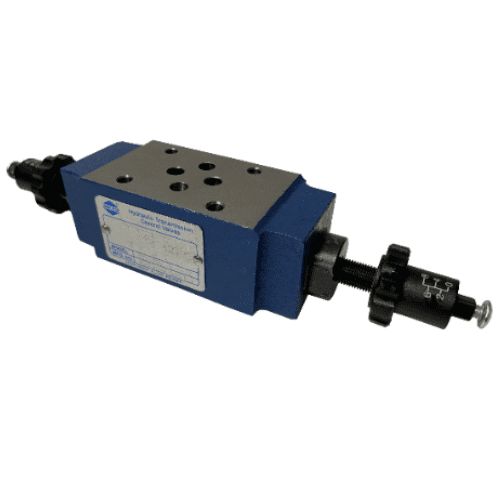
Modular Flow Control Valve - Cetop 3 (NG6) and Cetop 5 (NG10)
SKU TCV-MODULAR
AU$152.20
Model
Please choose
In stock
1
Save this product for later
Customer reviews
Reviews only from verified customers
No reviews yet. You can buy this product and be the first to leave a review.
Modular Flow Control Valve - Cetop 3 (NG6) and Cetop 5 (NG10)
Product Details
Brand: Timalco
Weight: 1.20 kg
A modular flow control sets the speed of the function without any extra plumbing. Bolt it into the stack and adjust.
Meter in or meter out?
Meter out restricts the oil leaving the actuator. This is the one you want on any load that can run away — lowering a boom, a vertical cylinder, a motor driving something with inertia. The oil on the outlet side does the holding, so the movement stays controlled.
Meter in restricts oil entering the actuator. Slightly more efficient and perfectly good on a resistive load that always pushes back, but it gives no control at all on an over-running load.
| Part number | Size | Function |
| TCV-02M-W-I | Cetop 3 | Meter in, A and B |
| TCV-02M-W-O | Cetop 3 | Meter out, A and B |
| TV-02M-P | Cetop 3 | Flow control on P |
| TCV-03M-W-I | Cetop 5 | Meter in, A and B |
| TCV-03M-W-O | Cetop 5 | Meter out, A and B |
| Z2FS6-30-S/S | Cetop 3 | Flow control, A and B |
| STD-VU-F-C3-A | Cetop 3 | Metered out of actuator |
If you are unsure, choose meter out. It is the safe default and the one that behaves predictably when the load helps rather than resists.
Modular valves stack. Each plate you add makes the assembly taller, so the mounting bolts must be longer — the bolt length in the table is what that single plate adds. Add up your stack and order the matching SHCS bolt set; they are not included.
Display prices in:AUD