
Categories
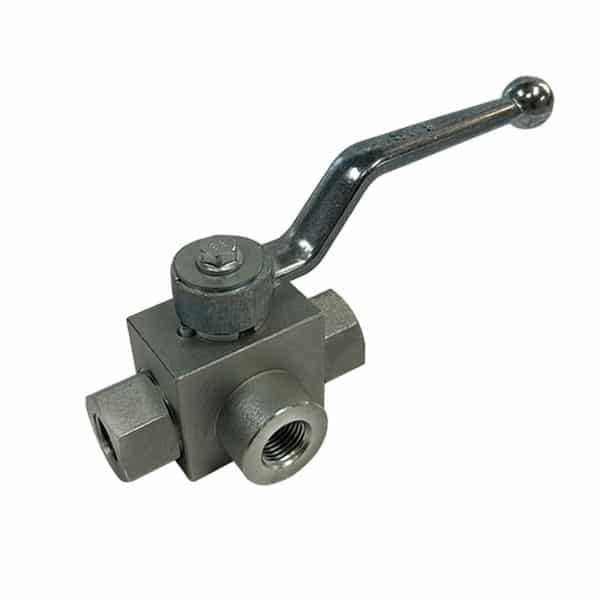
3-Way T-Port Hydraulic Ball Valve - 1/4" (6.4 mm) to 1" (25.4 mm) BSPP - 400 bar
SKU KHB3T-G1/4-06-11231-B-MH
AU$57.20
Port size
Please choose
In stock
1
Save this product for later
Customer reviews
Reviews only from verified customers
No reviews yet. You can buy this product and be the first to leave a review.
3-Way T-Port Hydraulic Ball Valve - 1/4" (6.4 mm) to 1" (25.4 mm) BSPP - 400 bar
Product Details
Weight: 0.90 kg
3-Way T-Port Hydraulic Ball Valve – BSPP, to 400 bar
The T-port gives you what an L-port cannot: a position where both outlets are fed at once. The ball is drilled in a T, so depending on lever position you get outlet A, outlet B, or both together. Use it for a straight run plus a branch, twin coolers, or feeding a gauge line while the circuit stays live.
How to order
Choose your port size above – the part code and price update as you pick. Everything here ships direct from the supplier, normally next business day on stocked sizes.
Specification – KHB3T 3-way T-port
| Port size | Part code | Max pressure |
| 1/4" (6.4 mm) BSPP | KHB3T-G1/4-06-11231-B-MH | 400 bar (5,802 psi) |
| 3/8" (9.5 mm) BSPP | KHB3T-G3/8-10-11231-B-MH | 400 bar (5,802 psi) |
| 1/2" (12.7 mm) BSPP | KHB3T-G1/2-13-11231-B-MH | 400 bar (5,802 psi) |
| 3/4" (19.0 mm) BSPP | KHB3T-G3/4-20-11231-B-MH | 350 bar (5,076 psi) |
| 1" (25.4 mm) BSPP | KHB3T-G1-25-11231-B-MH | 350 bar (5,076 psi) |
About this range
Same body, ball and handle as the L-port, different drilling. Carbon steel, BSPP parallel female ports, blow-out proof stem.
Be deliberate about this choice. Fitting a T where an L was intended means the circuit you thought you isolated is still live – on a loaded ram that matters. If you are replacing a failed valve, check the old one before ordering, or send us a photo.
Where this valve earns its money
Straight run plus a branch: feed the main circuit and tee off to a gauge, an accumulator or a second ram when needed. Twin coolers or twin filters: run one, the other, or both in parallel when the oil is hot. Filling and flushing: divert flow through a filter cart without breaking the circuit.
The both-open middle position is the whole reason to buy a T-port – and the reason to be careful with it. If one leg must be positively isolated, use the L-port instead: on a T there is always a lever position where your "isolated" leg is live.
Specification sheet
📄 KHB series specification (compiled from supplier data)
Which ball valve do I actually need?
| Isolate one line – shut a ram, lock out a circuit, tank shut-off | 2-way. One in, one out, quarter turn. Simplest and cheapest. |
| Choose between two circuits – tipper body or trailer, one pump feeding two tools | 3-way L-port. Feeds one outlet at a time, never both. |
| Feed one, the other, or both – straight run plus a branch, twin coolers | 3-way T-port. The T drilling gives you a both-open position. |
| Divert flow with a plain inline body – no bracket needed | 3-way L-port without mounting holes – the KHB3K hangs in the line on its own ports. |
| Padlock it for isolation – site lockout procedure | Any body above, plus a locking kit. |
Still not sure? Email the circuit or a photo of the old valve to sales@hydraulic.online. Getting a 3-way arrangement wrong is the single most common reason we get asked to swap a valve out, and from the outside they look identical.
The rest of the ball valve range
2-way Oleoweb3-way L-port Oleoweb2-way KHB3-way L-port KHB3-Way L-Port Inline – KHB3K2-way Taipan HPBV3-way T-port Taipan
Not sure which thread you have?
BSPP and BSPT look near identical until you try to seal them. Print the chart, lay your fitting on it, match the diameter and pitch.
⭐ Free Thread Identification Chart – print and measure
Technicians advice
Turn it fully, every time. A ball valve is either open or shut. Half-turned, the whole flow squeezes past the edge of the ball and across the seat, and the seat erodes – then it will not seal in either position. If you need to control flow, you want a needle or flow control valve, not a ball valve.
Never crack one open under full pressure to bleed a line. The entire differential lands on a knife-edge of seat material. Do it twice and the valve is scrap. Bleed with the pump off and the accumulator dumped.
Support the body, not the hoses. Anything from 3/4" (19.0 mm) up is heavy enough to fatigue a hose tail if it hangs there. Bracket the valve and let the hoses arrive relaxed.
Mind the trapped oil. Close a valve on the rod side of a loaded cylinder and that oil has nowhere to go – thermal expansion alone can lift pressure past the valve rating. Fit the valve on the pressure side of a relief, or use a valve with a bleed provision.
BSPP means a seal, not tape. These are parallel ports: use a bonded seal or an O-ring boss adaptor. Thread tape on a parallel thread does nothing except contaminate the oil.
Handle clearance. Before you tighten anything, swing the lever through its full travel and check it clears hoses, guards and knuckles. A valve you cannot reach or cannot turn is not an isolation valve.
Cycle it occasionally. A valve that sits untouched for two years will be stiff and may weep on first use. Give isolation valves a full open-shut once a service.
Need a size, port arrangement or body material you cannot see here? Email sales@hydraulic.online and we will price it properly.
Express shipping Australia-wide. We dispatch daily to New South Wales, Victoria, Queensland, Western Australia, South Australia, Tasmania, the Australian Capital Territory and the Northern Territory – Sydney, Melbourne, Brisbane, Perth, Adelaide, Hobart, Canberra and Darwin, plus regional and remote sites.
Display prices in:AUD